
The Sanctuary Drained: When the Water Ceases to Be a Safe Haven
When we talk about civil rights, segregation, and systemic racism, the conversation often gets trapped in history books. We tell ourselves that the battle was fought, the laws were passed, and equal access was achieved.
Following the 2026 midterm elections, Texas experienced a historic political shift. Just two days later, a poolside interaction at a municipal facility in Texas reminded me of a harsh truth: political leadership can shift overnight, but the deep-seated cultural habits of selective enforcement, hyper-vigilance, and implicit bias do not vanish with an election outcome. History mutates. The physical barriers of the past evolve into the invisible, selectively enforced boundaries of the present.
Just two days later, I was reminded of a harsh reality: political leadership can shift overnight, but the deep-seated cultural habits of selective enforcement, hyper-vigilance, and implicit bias do not vanish with an election outcome. History doesn't disappear when a law or a government changes—it mutates. The physical barriers of the past often evolve into the invisible, selectively enforced boundaries of the present.
The Lethal Weight of "Perceived Threat"
If you stand 6-foot-5 and walk into any room, your height commands immediate presence. When you are a 6-foot-5 Black man, however, that natural presence is constantly reinterpreted through the lens of implicit bias. A relaxed posture is misread as intimidation. Occupying standard physical space is perceived as taking up "too much" room. Navigating everyday life requires a continuous, exhausting tax: managing everyone else’s unexamined hyper-vigilance.
I once had a conversation with a white police officer at a brightly lit public diner. He was in full uniform—wearing a bulletproof vest and carrying a sidearm. I was casually dressed, unarmed, sitting there as a civilian.
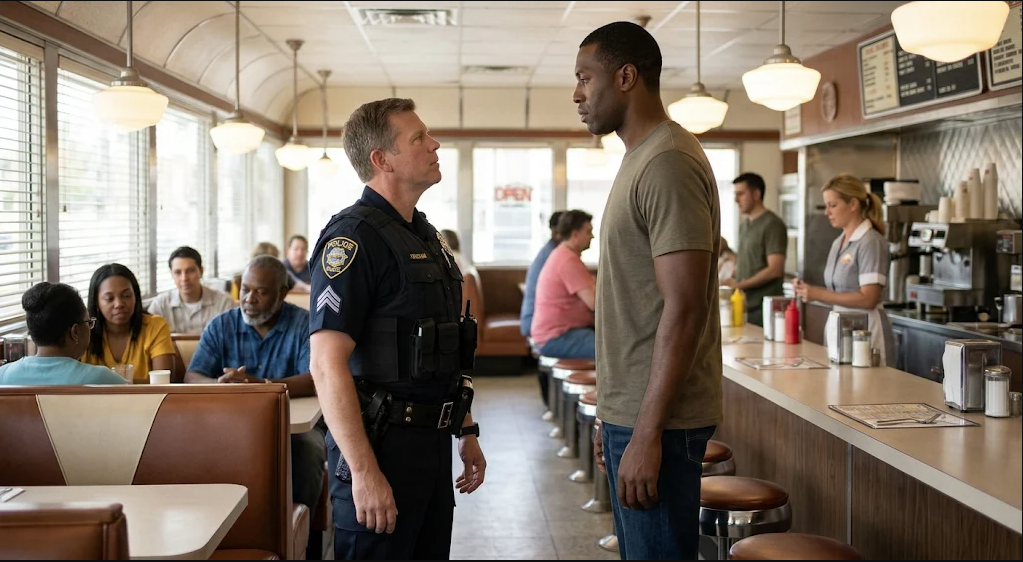
Out of nowhere, he admitted to me that he would be "afraid to run into me in a dark alley."
Here was a man backed by the full power of law enforcement, fully armed and armored, telling me that my sheer physical existence invoked fear. I sat across from him with a chilling realization: I am afraid of you right now. In America, that officer could draw his weapon in that well-lit diner, surrounded by witnesses, and if he took my life, he could claim he "feared for his safety" simply because I am tall and Black—and that subjective fear would be accepted as a legal justification.
When your body is automatically criminalized and weaponized by the minds of others, existing in public space is never neutral. It is fraught with invisible danger.
The Sanctuary of the Water
That is why the water was always supposed to be different.
I earned my scuba diving certification while attending Hampton University, a Historically Black College (HBCU) with a rich tradition of excellence and empowerment. As a certified scuba diver, I have had the privilege of viewing the world from 90 feet below the surface of the ocean—a silent, weightless realm where race, stature, and human prejudice do not exist.

Whether diving deep in the ocean or swimming lap after lap counting tiles on the bottom of a pool, the water was my sanctuary. Out on the street, you have to monitor your posture, soften your voice, and constantly reassure the people around you that your height is not a threat. But under water, there are no microaggressions. There is only breathing, buoyancy, stroke count, and momentum. The water was the one place where your body could just be.
Until it wasn't.
The View from 6-Foot-5: Physical Reality vs. Selective Enforcement
Beyond the psychological sanctuary, swimming also involves basic physics and human physiology. At 6-foot-5, an individual's wingspan (arm span) typically matches or exceeds their height. In a standard municipal lap lane—roughly 6 to 7 feet wide—a swimmer with a 6-foot-5 arm span completely spans the space from lane line to lane line during backstrokes, butterfly, and recovery phases of the freestyle stroke.
Forcing a swimmer of that stature to share a lane isn't just an inconvenience—it is an active safety hazard. Stray limbs, flip-turn blind spots, and high-impact mid-lane collisions become immediate risks.
A Scene Out of Time: The All-White Deck Dynamic
Picture this: You enter a municipal pool facility as a dues-paying member. You sign the official log board, wait your turn patiently in the hot tub, and enter an open lap lane only after the previous swimmer finishes and notifies you. You are in your lane, swimming your laps, finding that familiar sanctuary.
Then, a white member sits on the edge of the pool wall and demands that you—and specifically you—give up half your lane so he can swim.
There are three lanes in the pool. Lanes 1 and 3 each have a single swimmer occupying them. Neither the white patron nor the facility staff asks the swimmers in Lane 1 or Lane 3 to share. Instead, a group of half a dozen staff members—three lifeguards and two to three managers, all of whom are white—gather poolside to repeatedly approach, target, and press you to yield your space while you are mid-lap.
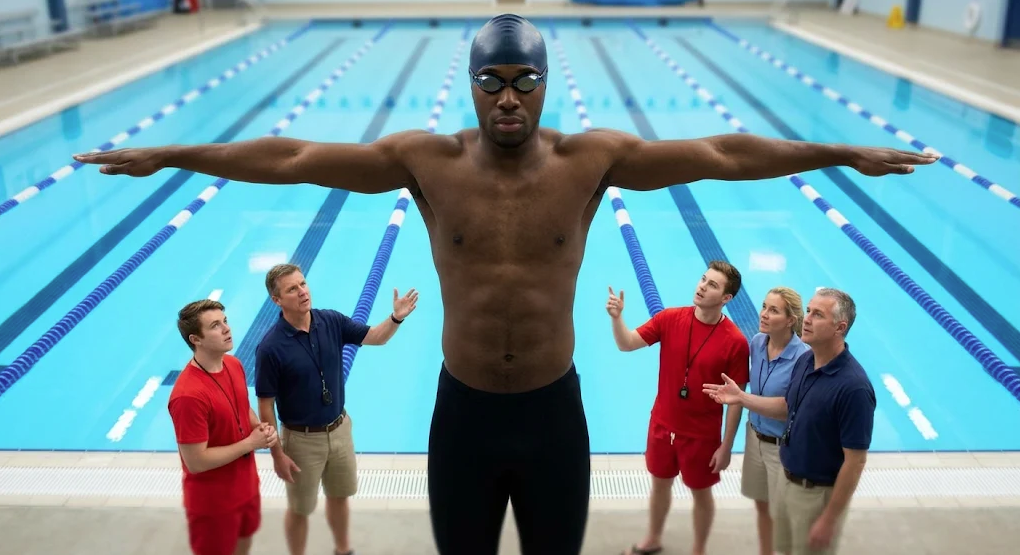
When you pause to hold out your arms—demonstrating that your wingspan reaches from rope to rope, creating severe safety risks for backstrokes and turns—the physical logic is ignored. The white staff members side with the white patron, fixating entirely on dislodging the single Black swimmer in the water.
When your sanctuary is invaded like that, the illusion shatters. The realization hits hard: the same implicit bias that makes a uniformed cop fear you in a diner is what makes an all-white pool staff view your presence in a lap lane as an obstacle that must be removed.
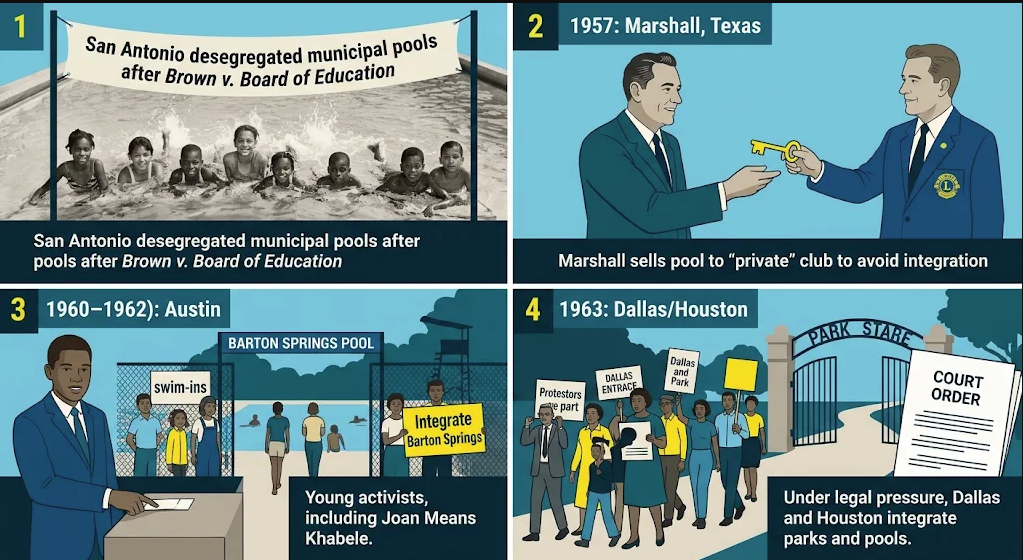
Historical Context: Public Pool Access in Texas
│
├── 1954: Brown v. Board ruling prompts early integration in San Antonio pools.
├── 1957: Marshall sells its public pool to a private group to avoid integration.
├── 1960–1962: Joan Means Khabele leads swim-ins at Barton Springs in Austin.
├── 1963: Dallas & Houston integrate city pools under legal pressure.
└── Present Day: Physical barriers shift to selective policing and implicit bias.
The Director’s Email: A Study in Institutional Minimization
When I requested the preservation of surveillance video and a substantive response, the facility Director provided an official reply. It is an instructive lesson in how institutional language sanitizes structural privilege:
1. Rationalizing Intimidation as "Common Practice"
The facility defended six white staff members simultaneously surrounding a single Black swimmer as "common practice" because "we do not know beforehand the circumstance going on." This rationale completely ignores context: this was not a medical emergency or a violent altercation. It was a minor rule interpretation dispute. Normalizing this disproportionate gathering of force as policy is designed to intimidate. It is how systemic bias rationalizes the over-policing of a Black presence in public space.
2. Disregarding Elevated Safety Risks for Seniors
When forced to address the 6'5" wingspan collision risk in a 55+ facility, the response was to treat basic physics as a subjective comparison of skill:"We understand you are tall; we have many other members around or the same height as you... there have been no reports of injuries."
Relying on a lack of prior reported injuries in a senior pool while actively forcing a high-impact collision hazard is negligent. The physical logic is absolute: two bodies with wide wingspans cannot safely pass during backstrokes or freestyle recoveries in a 6-foot lane without risk of impact.
3. Selective Enforcement and Conditional Access
The email explicitly conceded that the other lanes were available and that the difficult patron "picked lane 2," yet it offered no explanation for why six staff members applied selective enforcement to the single Black swimmer rather than addressing the intransigence of the white member.
From Physical Fences to Selective Enforcement
When Texas cities were forced to desegregate their municipal pools in the late 1950s and 1960s, the reaction was telling. In places like Marshall, Texas, local leaders sold public pools to private organizations to maintain exclusion under the guise of "private property." In other cities, public pools were drained, filled with dirt, or defunded, giving rise to private suburban swim clubs.
The core impulse was clear: If shared space cannot be controlled, it will be dismantled or restricted.
Decades later, legal barriers are gone, but the cultural habit of selective enforcement remains—regardless of who holds political office at the state level. When an all-white staff repeatedly pressures the only Black swimmer in a facility to yield his lane—ignoring available white swimmers in adjacent lanes and disregarding clear safety warnings about physical wingspan—it is not an accident of bad communication. It is the continuation of an unspoken idea that Black access to public amenities is conditional, subject to the comfort, convenience, and authority of white patrons and management.

Protecting the Next Generation: The Mission of B.E.A.M. Education
As President of B.E.A.M. Education, this experience is not just personal—it is instructional. It exposes the exact framework we must disrupt.
The microaggressions I faced on that pool deck mirror the systemic headwinds our Black and Brown children encounter daily in public spaces, particularly in traditional educational systems:
Selective Discipline: Just as staff singled out the only Black swimmer while ignoring others, students of color are disproportionately targeted and penalized for standard behaviors.
The Threat of Presence: Just as a tall Black man occupying a lane is viewed as an intrusion, young Black scholars are frequently adultified and labeled as "disruptive" simply for taking up space and exercising voice.
Conditional Belonging: When unexamined bias governs an institution, children learn that safety and acceptance depend on keeping others comfortable.
This is precisely why we built alternatives. Through B.E.A.M. Microschool Academy and B.E.A.M. H2O Homeschool Enrichment, we refuse to fit our children into a flawed, reactive system. Instead, we build a proactive ecosystem centered on Equitism™—ensuring every learner ages 5–10 is deeply known, uniquely valued, and supported through identity-honoring, project-based mastery.
Reclaiming Our Future Together
Top-down political changes alone will not fix the micro-level realities in our community facilities and classrooms. True Equitism™ is not achieved merely when state leadership changes or when doors are unlocked; it is achieved when local systems, policies, and practices are actively redesigned to eliminate bias.
Whether looking up from 90 feet below the ocean or standing in a vibrant, supportive classroom, our goal remains clear: replacing arbitrary restrictions with true human flourishing.

Join the Movement
We don't just have to weather the challenges of today—we can design the brilliant, liberated future our children deserve.
Connect with our mission and share your story: Visit B.E.A.M. Education to connect with us, share your personal challenges of today, and let us know your vision of a better future for us all to work toward.
Explore our Microschool: Discover full-time, culturally responsive project-based learning for ages 5–10 at B.E.A.M. Microschool Academy.
Explore Homeschool Enrichment: Check out flexible 1-to-3-day weekly enrichment, Legacy Labs, and Signature LAB Days at B.E.A.M. H2O.


