Where Is Africa In The Odyssey? Homer Told Us All Along
Christopher Nolan brought the ancient poem by Homer to the biggest screens in the world on July 17, 2026, and families everywhere have been watching The Odyssey for the first time. A lot of parents and children ask the same sharp question once the movie ends: where are the people of Africa in this story. It is a fair question, and it has a real answer. Homer placed Africa inside this story from the very first page, long before anyone bought a movie ticket.

What The Odyssey Is Actually About
The Odyssey is a poem written by a Greek poet named Homer, somewhere around 2,700 years ago. It follows a Greek king named Odysseus as he spends ten long years trying to sail home to his island of Ithaca after fighting in the Trojan War. Along the way he meets gods, monsters, and one dangerous temptation after another, while his wife Penelope and his son Telemachus wait for him at home. Most of the poem takes place among Greek islands and the open sea, so at first it can look like an all Greek story.
The new film already started a big conversation about who gets to tell this story. Nolan cast Lupita Nyong'o, an Oscar winning actress with Kenyan roots, to play both Helen of Troy, the woman blamed for starting the Trojan War, and her sister Clytemnestra. The casting drew both praise and criticism, and Nyong'o has spoken publicly about why she believes a cast that represents the whole world fits a story this large. That conversation matters. But it is only the newest chapter. Homer put Africa into this story thousands of years before any of us were born.
The Ethiopians Who Open And Close The Whole Poem
Turn to the very first page of The Odyssey and Africa is already there. Homer tells us that the sea god Poseidon has left Mount Olympus to visit a people he calls the Ethiopians, described as split between the far east and the far west edges of the known world, and treated as favorites of the gods. The other gods meet without Poseidon because he is feasting with the Ethiopians at that very moment. Near the end of the poem, Poseidon is sailing home from that same visit when he spots Odysseus at sea and grows angry all over again. Homer opens and closes the entire adventure by pointing his readers toward Africa. In the earlier poem called the Iliad, Homer describes those same Ethiopians as such devoted and honorable people that Zeus himself leaves Mount Olympus just to feast with them. For a poet writing around 700 BC, that is a remarkable amount of respect to give one group of people.

Egypt Shows Up Inside The Story Itself
Egypt is not just mentioned in passing either. In Book 4 of the poem, the Spartan king Menelaus tells young Telemachus about years he spent sailing to Cyprus, Phoenicia, Egypt, Ethiopia, and Libya on his own long trip home from Troy. And when Helen wants to calm a room full of grieving guests, she does not reach for a Greek remedy. She uses a drug called nepenthe, and Homer tells us exactly where it came from: Egypt, a rich and fertile land where the earth grows countless drugs, some healing and some harmful, and where the people understand medicine better than anyone else alive at the time. The two people who actually hand Helen that famous drug are named in the poem: Thon, an Egyptian nobleman, and his wife Polydamna. In a story full of Greek gods and monsters, Homer chose an Egyptian couple to hold the one piece of real world knowledge that saves the day.

Memnon, The King Who Almost Beat Achilles
The Odyssey has a sister story called the Aethiopis, an epic written soon after the lifetime of Homer that has mostly been lost, though we still know its plot from later writers. In it, an African king named Memnon leads an army from Ethiopia to defend Troy after the Greek hero Hector is killed. Memnon fights so well that ancient writers ranked him second only to Achilles among every warrior at Troy, and he kills the son of the wise old counselor Nestor before Achilles finally strikes him down. Ancient Greek artists could not stop painting him. His face still survives today on vases and carvings close to 2,500 years old.
It is worth being honest here. Ancient writers did not always agree on exactly where the Ethiopia of Memnon was located. Some placed it in the east, near Persia. But the stronger and more lasting tradition, especially in later Greek and Roman art, ties Memnon to the land of Nubia, south of Egypt, in Africa. Either way, one fact does not change. The Greeks imagined one of the bravest warriors to ever fight at Troy as an African king.
The Real History Hiding Behind The Poem
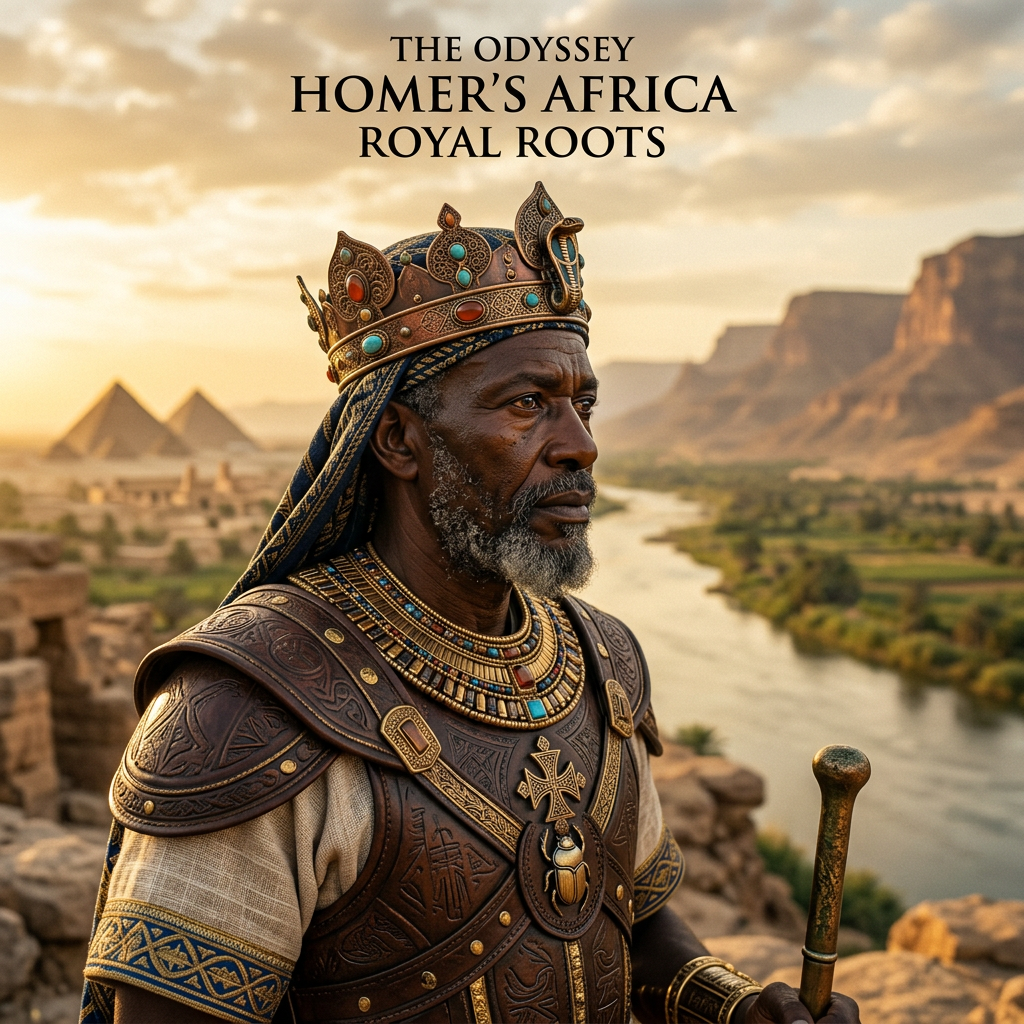
Here is the part that turns all of this from a nice detail into something much bigger. Homer is generally believed to have composed The Odyssey somewhere around the 8th or 7th century BC. That is the exact same century when African kings from the Kingdom of Kush, a civilization based in what is now Sudan, conquered Egypt and ruled it as pharaohs. History remembers kings like Piye and Taharqa as the Black Pharaohs of the 25th Dynasty, and they ran one of the most powerful kingdoms on earth at that time. So when the audience of Homer pictured Egypt as a wise and wealthy land, and pictured Ethiopia as a place the gods themselves loved to visit, real African kings were, at that very moment, sitting on the throne of Egypt. The poem was not imagining greatness in Africa. It was living right next door to it.

Why This Matters For Our Children
This is exactly why programs like Royal Roots at B.E.A.M. H2O exist. Our children deserve to know that greatness connected to the history of marginalized groups does not begin with slavery and does not begin with struggle. It begins thousands of years earlier, inside the oldest stories human beings ever wrote down. As Dr. Andrea Long-Nelson often says, environments are spaces, ecosystems are relationships, and relationships are where transformation happens. When our children build a relationship with their own deep history, all the way back to Homer and the Kingdom of Kush, that relationship becomes the foundation for everything we hope for them.
Want your child to grow up knowing this kind of history as their own. Subscribe to Royal Roots or book a family appointment today at beamh2o.org.
